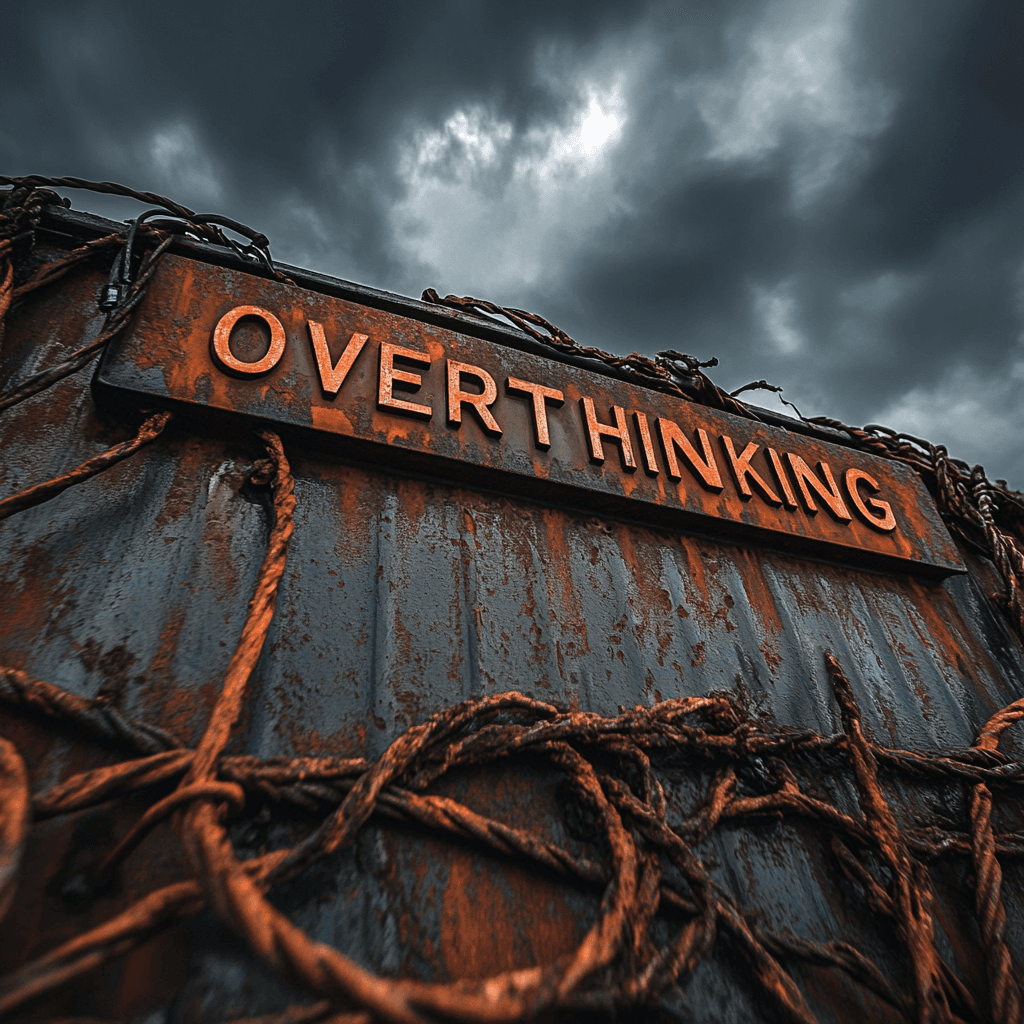
There's a version of thinking that looks a lot like progress. You're engaged with the problem. You're taking it seriously. You're not avoiding it — if anything, you can't stop engaging with it.
And yet three hours later you're in the same position you started, slightly more anxious, and the problem hasn't moved an inch.
That's rumination. And the most frustrating thing about it is how productive it feels while it's happening.
The difference between thinking and ruminating
Reflection is forward-looking. You take an event, you extract something from it — an understanding, a decision, a reframing — and then you put it down. The thought had somewhere to go.
Rumination is circular. You take the same event and run it through the same questions on repeat: Why did that happen. What should I have said. What does it mean. What's going to happen now. The questions don't resolve because they weren't designed to resolve. They were designed to run.
It feels like thinking because you are, technically, thinking. Your brain is active. You're engaged with real content. But you're going around the same track with no exit ramp, which means all that cognitive activity isn't actually getting you anywhere new.
The output of reflection is insight. The output of rumination is more rumination.
What it's doing under the surface
Rumination tends to masquerade as preparation. "If I think about this enough, I'll understand it. If I understand it, I'll be ready for the next thing. If I'm ready, I'll be safe."
There's a logic there — just a faulty one. Because the things that trigger rumination are almost always things that have already happened (unchangeable) or things that might happen (unknowable). Neither category benefits from being replayed. Both categories feel like they might, which is the trap.
What's actually happening, beneath the apparent problem-solving, is usually an attempt to control through thought something that cannot be controlled. The past is fixed. The future is not yet here. Thinking about both of them very hard does not change either of them.
What it does do is keep the nervous system activated. Keep the sense of threat present. Keep you from accessing the rest and perspective that would actually help.
The body is involved
Rumination isn't only a mental event. When you're in a loop, your body is responding as if the thing is happening now — elevated heart rate, tight chest, shallow breath, the specific physical quality of being on alert. Which then feeds the loop. Which then feeds the body. And so on, for hours, while you sit very still on the sofa.
This is why "just stop thinking about it" is profoundly useless advice. The loop isn't purely cognitive. You need to interrupt it at the level of the body as much as the mind.
What actually interrupts it
Physical movement. Not as a distraction — as a genuine pattern interrupt. A brisk walk, a cold shower, anything that changes the physical state, tends to break the loop in a way that arguing with yourself about whether you should stop thinking does not.
Writing it down. Not to analyse it, but to externalise it. Getting the loop out of your head and onto paper removes the sense that you have to hold it. The act of writing it tends to reveal how repetitive it is — which is slightly embarrassing, but also informative.
Giving it a time slot. This sounds strange, but scheduling a fifteen-minute block for "I will now think about this problem" and then actually keeping to the time limit trains the brain that the topic has a container. You don't have to resolve it — you just have to put it down when the time's up.
The goal isn't to stop thinking. It's to think in a way that has an exit.
The self-compassion bit (non-negotiable)
Being hard on yourself for ruminating is, ironically, one of the most reliable ways to feed it. Now you have two loops: the original topic, and the story about what it says about you that you can't stop.
Rumination is a very human response to uncertainty and pain. It's your brain doing something inefficient in service of trying to protect you. That deserves some patience, even when it's driving you up the wall.
Notice the loop. Name it. Change the physical state. Then, gently, give it something else to do.